
After an accident, it is easy to think the process works like this:
You were injured → the other driver was at fault → the insurance company pays.
Sometimes a claim can be relatively straightforward.
But insurance companies generally do not evaluate injury claims based on one sentence.
They investigate.
An adjuster may want to understand what happened, who was responsible, what injuries resulted, what treatment was necessary, and how much the accident actually cost.
That can feel frustrating when you are the person dealing with the pain.
But understanding what is being evaluated can make the process a lot less mysterious.
This guide breaks down the major questions that can arise when an insurer reviews a Dallas personal injury claim—and what you can do to keep your side of the story organized.
Quick Answer
Insurance companies may evaluate a Dallas injury claim by looking at:
- How the accident happened
- Who appears responsible
- What evidence supports liability
- Whether the medical treatment connects to the accident
- How serious the injuries are
- Whether treatment is continuing
- What income or other financial losses occurred
- What insurance coverage is available
- Whether the documentation supports the amount being claimed
- Whether the claim should be resolved through settlement or another process
Texas Department of Insurance explains that an insurance adjuster reviews what happened, estimates the claim payment, may inspect damage, review police reports, talk with witnesses, and request additional information.
The Claim Is More Than A Medical Bill
This is one of the most important things to understand.
An injury claim is not simply:
“Here is my hospital bill.”
The insurer may be trying to answer several separate questions.
Liability
Who caused the accident?
Causation
Did the accident cause the claimed injury?
Severity
How serious is the injury?
Treatment
What care was required?
Financial Impact
What did the injury cost?
Future Impact
Is additional treatment or another significant loss reasonably expected?
Documentation
Can the claimed losses be supported?
Think of the claim as a collection of connected questions rather than one giant number.
Step One: How Did The Accident Happen?
Before an insurer can evaluate an injury claim, it needs to understand the accident itself.
An adjuster may review:
- Police reports
- Driver statements
- Witness accounts
- Photographs
- Video
- Vehicle damage
- Roadway conditions
TDI says adjusters may inspect damages, review police reports, talk to witnesses, and ask for additional information while reviewing claims.
That means the photographs you took immediately after the accident may matter months later.
So can the witness whose phone number you saved.
Liability Is Often The First Big Question
Imagine a Dallas intersection.
Two drivers collide.
Both say the other driver had the green light.
The insurance companies cannot simply accept both versions.
They need evidence.
That might include:
- Traffic-camera footage
- Dashcam footage
- Witness statements
- Vehicle positions
- Damage patterns
- Police observations
- Photos of the intersection
The clearer the evidence, the easier it may be to understand what happened.

Comparative Responsibility Can Matter
Texas does not always treat responsibility as an all-or-nothing question.
Chapter 33 of the Texas Civil Practice and Remedies Code establishes a proportionate-responsibility framework for covered tort actions.
Among other provisions, Section 33.001 states that a claimant may not recover damages in an action to which the chapter applies if the claimant’s percentage of responsibility is greater than 50 percent.
That means an insurer may pay attention to allegations that the injured person also contributed to the accident.
For example:
“The other driver caused the crash.”
is different from:
“The other driver caused the crash, but the insurer says you were also partially responsible.”
Those are very different claim situations.
Step Two: Does The Medical Evidence Match The Accident?
Once responsibility is being evaluated, the insurer may also look closely at the injury.
This is where medical documentation becomes important.
The insurer may want to understand:
- What symptoms were reported
- When they began
- What was diagnosed
- What treatment was provided
- How long treatment lasted
- Whether additional care was recommended
The goal is to understand the connection between the accident and the claimed injury.
Timing Can Matter
Imagine two timelines.
Timeline A
Crash → same-day evaluation → diagnosis → treatment
Timeline B
Crash → several weeks → first medical appointment
Neither timeline automatically proves or disproves a claim.
There may be perfectly reasonable explanations for delayed treatment.
But the difference can lead to additional questions.
If there was a delay, explain it honestly to your healthcare provider and keep appropriate records.
Treatment History Is More Than A List Of Appointments
Suppose someone attends:
- Emergency care
- Primary-care visits
- Physical therapy
- Specialist appointments
The insurer may look at the overall treatment pattern.
Questions can include:
- Was treatment consistent with the claimed injury?
- Did symptoms improve?
- Did symptoms continue?
- Was additional treatment recommended?
- Did the person follow the treatment plan?
TDI advises claimants to keep medical records and bills after a wreck and to provide relevant medical documentation when appropriate.
Gaps In Treatment Can Create Questions
A treatment gap is not automatically a reason to deny an injury claim.
Life happens.
People have work obligations.
Transportation can be difficult.
Medical costs can be overwhelming.
Symptoms can fluctuate.
But if there is a significant gap, the insurer may ask why.
The best approach is not to invent an explanation.
Document the real one.

Step Three: How Serious Is The Injury?
Not all injuries create the same claim.
An adjuster may consider the nature and extent of the injury.
For example, there can be a significant difference between:
A minor injury that resolves quickly
and
An injury requiring surgery, rehabilitation, and continuing care.
The documentation should explain the difference.
That may include:
- Diagnoses
- Imaging
- Treatment records
- Specialist opinions
- Therapy records
- Restrictions
- Prognosis
The Medical Bill Is Not The Whole Medical Story
A $5,000 medical bill does not necessarily tell you everything about an injury.
Neither does a $50,000 bill by itself establish a particular settlement value.
The insurer may consider the broader medical picture.
That includes what treatment was provided and why.
Step Four: What Did The Injury Cost You?
Now the claim moves into financial losses.
Medical expenses may be obvious.
But an injury can affect other parts of your finances.
Potential documentation can include:
- Pay stubs
- Employer records
- Time sheets
- Leave records
- Transportation expenses
- Prescriptions
- Medical equipment
- Other accident-related receipts
TDI recommends keeping receipts and documentation associated with insurance claims.
Lost Income Can Be Easy To Underestimate
Consider someone who normally earns a salary but misses several weeks of work.
The loss may include more than the obvious missed pay.
Depending on the circumstances, there could also be:
- Lost overtime
- Reduced hours
- Missed shifts
- Changes in job duties
- Extended work restrictions
Good documentation helps show what actually happened.
What About Future Losses?
This is where an injury claim can become more complicated.
Suppose a person is still receiving treatment.
It may be too early to know the final medical outcome.
There could be:
- Additional therapy
- Specialist care
- Surgery
- Long-term limitations
That does not mean a future loss should simply be guessed.
Future damages generally require appropriate evidence and case-specific analysis.
Step Five: What Insurance Coverage Is Available?
Even when responsibility seems clear, another question remains:
What insurance coverage is actually available?
Depending on the circumstances, a claim may involve:
- The at-fault driver’s liability coverage
- Your own uninsured/underinsured motorist coverage
- Other potentially applicable policies
TDI explains that uninsured/underinsured motorist coverage can become relevant when the responsible driver has no insurance or insufficient insurance, subject to the terms of the policy and applicable requirements.
Coverage questions can become particularly important when injuries are serious and losses exceed the other driver’s available limits.
The Policy Matters
Insurance coverage is contractual.
TDI advises consumers to read their policies carefully rather than relying solely on an agent’s explanation of what is covered.
That is good advice generally.
If you do not understand why an insurer says a particular coverage does or does not apply, ask for an explanation and review the policy language.
Step Six: What Does The Documentation Actually Show?
This is where all the pieces come together.
Imagine an insurer receives:
- A police report
- Accident photographs
- Witness information
- Medical records
- Medical bills
- Pay records
- Expense receipts
Now compare that with a claim supported by:
- One accident photograph
- A brief medical summary
- No wage documentation
- No receipts
- Conflicting descriptions of the accident
The first file is easier to evaluate.
That does not guarantee a particular result.
It simply provides more documentation.
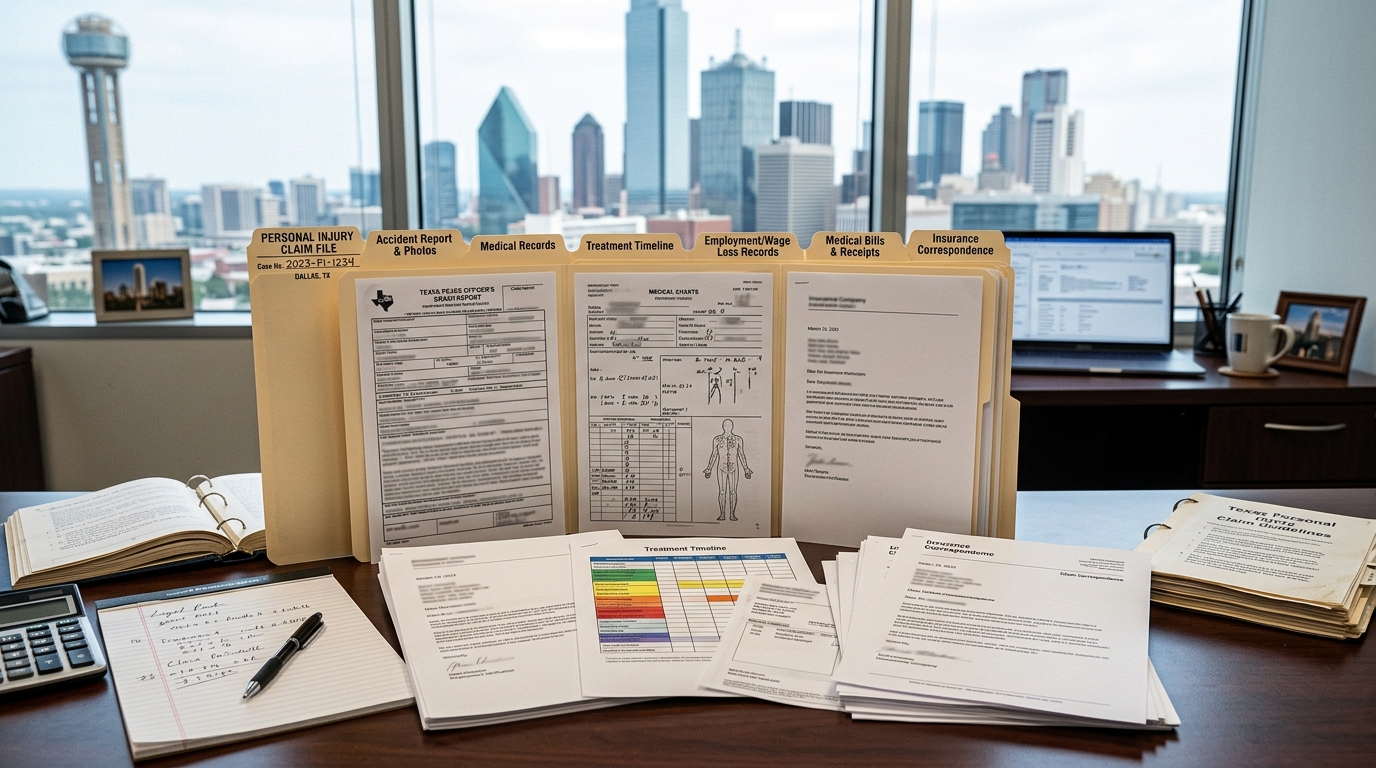
Build A Claim File Before You Need It
A simple folder system works well.
Accident
- Photos
- Videos
- Police report
- Witness information
Medical
- Records
- Bills
- Prescriptions
- Therapy documentation
Financial
- Pay stubs
- Employer records
- Receipts
- Transportation expenses
Insurance
- Claim number
- Adjuster contact information
- Emails
- Letters
- Settlement offers
TDI recommends keeping copies of claim documents and notes from conversations with insurance representatives.
What An Adjuster May Ask You
Do not be surprised if an adjuster asks questions you feel you have already answered.
They may want details about:
- The accident
- Your injuries
- Medical treatment
- Prior or ongoing symptoms
- Work limitations
- Property damage
- Other insurance
The safest approach is straightforward:
Tell the truth.
If you do not remember something, say that.
Do not guess.
Do not exaggerate.
Do not minimize an injury because you are worried about sounding dramatic.
Keep A Record Of Every Important Conversation
This is a small habit that can save you considerable frustration.
After a call, write down:
Date: September 8
Time: 2:15 p.m.
Person: Claims representative
Topic: Requested medical records
Next step: Send records by email
TDI recommends keeping notes of insurance calls, including the date and the name or title of the person you spoke with.
Ask Questions When Something Is Unclear
If the insurer requests a document, ask:
“What document do you need?”
If an offer seems unclear:
“Can you explain how this amount was calculated?”
If something is denied:
“Can you explain the reason for the denial?”
TDI advises consumers to ask the insurer to explain the basis for a settlement position and, where appropriate, identify the policy language being used.
You do not need to be confrontational.
You need to understand what is happening.

What If The Insurance Company Offers A Settlement?
Eventually, an insurer may make an offer.
That can feel like a relief.
Someone is finally offering money.
But slow down.
A settlement offer should be evaluated in light of the full claim.
Ask yourself:
- Is medical treatment finished?
- Do doctors expect additional treatment?
- Have all medical expenses been identified?
- Have lost wages been documented?
- Are other accident-related expenses included?
- Does the settlement release future claims?
TDI specifically warns consumers to consider potential future medical treatment before signing a release connected to an injury settlement.
A Settlement Number Does Not Explain Itself
Suppose an insurer offers $25,000.
The useful question is not simply:
“Is $25,000 a lot or a little?”
The better questions are:
What does the $25,000 include?
What evidence supports the losses?
Is treatment finished?
Are future losses possible?
What rights are being released?
Without that context, the number alone does not tell you much.
What If The Insurer Says Your Claim Is Worth Less?
You have options.
Start by asking why.
Maybe the insurer believes:
- You share responsibility for the accident.
- Some treatment is unrelated.
- Certain expenses are unsupported.
- Additional documentation is needed.
- The policy provides limited coverage.
If you disagree, respond with documentation addressing the specific issue.
TDI advises consumers who disagree with an insurer’s position to communicate with the company and provide supporting documentation.
Do Not Treat Every Disagreement As A Personal Attack
Insurance claims can become emotional.
You are dealing with an injury.
You may feel that the insurer is questioning your honesty.
Try to separate the emotion from the documentation.
If the insurer asks:
“Why did you miss three weeks of work?”
the strongest response may simply be:
“Here is the employer documentation showing my leave dates.”
Evidence is often more useful than an argument.
When An Injury Claim May Need Legal Guidance
Not every claim requires an attorney.
You may be comfortable handling a relatively straightforward claim when:
- Injuries are minor
- Fault is clear
- Treatment is limited
- Financial losses are small
- The insurer is cooperating
But legal guidance can become more valuable when the situation is different.
Serious Injuries
For example:
- Surgery
- Traumatic brain injury
- Spinal injury
- Permanent impairment
- Significant rehabilitation
Disputed Liability
The insurer says you caused or contributed to the accident.
Ongoing Treatment
You do not yet know the full medical outcome.
Significant Lost Income
You cannot return to your normal job or hours.
Multiple Parties
Several people or companies may share responsibility.
Insurance Disputes
Coverage, liability, or the amount of the claim is contested.
In those situations, dallas personal injury lawyers may help you understand how the evidence fits together and what options may be available.
What A Lawyer May Look For That You Missed
Sometimes the value of legal guidance is not simply negotiating harder.
It is spotting questions you did not know to ask.
For example:
Was there another responsible party?
Is there additional insurance coverage?
Does the medical evidence support future treatment?
Has important evidence been preserved?
Has the insurer overlooked a category of loss?
What deadline applies?
Those questions can become increasingly important as a claim becomes more serious.
Texas’s Legal Deadline Should Stay On Your Radar
Texas Civil Practice and Remedies Code §16.003 generally provides a two-year limitations period for many personal injury actions. Different rules and exceptions can apply to particular claims.
Insurance negotiations do not mean you should ignore the legal deadline.
A claim can remain under discussion while time passes.
If you are considering legal action, find out what deadline applies to your specific situation well before it becomes urgent.
What If The Insurance Company Is Taking Too Long?
Start by asking for a status update.
Keep records of:
- When the claim was submitted
- Documents you provided
- Follow-up calls
- Adjuster responses
- Any written explanation for delays
TDI provides consumer guidance about claim timelines and explains that insurers have statutory deadlines for certain claims handled under a policy, while different rules can apply when pursuing another driver’s insurer.
If you believe your own insurer is not handling a claim properly, TDI provides a complaint process for certain insurance disputes.
A Simple Way To Think About Insurance Evaluation
Imagine the adjuster’s file has six questions on the front.
1. What happened?
Accident evidence.
2. Who caused it?
Liability evidence.
3. What happened medically?
Treatment evidence.
4. What did it cost?
Financial evidence.
5. What happens next?
Future treatment and losses.
6. What coverage applies?
Insurance policy and coverage evidence.
If you can clearly document each question, you have a much more organized claim file.
Dallas Injury Claim Preparation Checklist
Accident Evidence
- Photograph vehicle damage
- Photograph the accident scene
- Save video
- Record witness information
- Obtain the police report when available
Medical Evidence
- Keep medical records
- Keep medical bills
- Track appointments
- Save prescription records
- Follow up on recommended treatment
Financial Evidence
- Save pay stubs
- Track missed work
- Keep employer documentation
- Save receipts
- Record other accident-related expenses
Insurance Evidence
- Save your claim number
- Record the adjuster’s contact information
- Keep copies of emails
- Save letters
- Document phone calls
- Keep settlement offers
Before Accepting A Settlement
- Understand what the offer covers
- Consider whether treatment is complete
- Review future medical needs
- Check lost-income documentation
- Understand what rights the release affects
FAQ
An insurer may consider liability, medical treatment, the nature and severity of the injury, documented financial losses, available insurance coverage, and other evidence. There is no universal formula that produces the same settlement for every injury claim.
An adjuster investigates the claim and may review police reports, photographs, witnesses, and other information when evaluating responsibility. An insurer’s position is not necessarily the final legal determination of fault.
A treatment gap can lead to questions about the injury timeline, but it does not automatically invalidate a claim. There may be legitimate reasons for delayed or interrupted treatment. Accurate documentation and honest explanations are important.
Do not assume the first offer represents the full value of your claim. Before signing a release, consider whether treatment is complete, whether future care may be needed, and whether your losses have been fully documented. TDI specifically advises considering future medical treatment before signing an injury settlement release.
Consider legal guidance when the injury is serious, fault is disputed, treatment is ongoing, significant income has been lost, multiple parties may be responsible, insurance coverage is complicated, or the settlement offer does not appear to address the documented losses.
Final Thoughts
Insurance companies have a job to do.
They investigate claims.
They review evidence.
They calculate payments.
They ask questions.
That does not mean you have to approach the process as if you are fighting an invisible machine.
Understand what the claim needs to show.
What happened?
Who was responsible?
What injury resulted?
What treatment was necessary?
What did the injury cost?
What may happen next?
Then document each answer.
Keep the photographs.
Save the medical records.
Track the bills.
Document missed work.
Keep your insurance correspondence.
And when the claim becomes too complicated to confidently handle on your own, consider getting legal guidance.
For Dallas residents looking for a local resource, Dallas injury claim resources from Thompson Law provide a starting point for learning more.
You can also use the Thompson Law Dallas profile for local contact and directions information.