

Many people drive every day without thinking about it.
You check your mirrors.
You turn your head.
You rotate your body to look around.
You press pedals.
You maintain posture for long periods.
After an injury, these simple movements can suddenly become uncomfortable or difficult.
A person recovering from a car accident may notice that driving feels different because pain, stiffness, reduced mobility, or changes in confidence can affect everyday tasks.
If you are researching an auto accident chiropractor after a collision, understanding why driving can become challenging can help you identify what information matters during recovery.
Why Driving Requires More Movement Than People Realize
Driving appears simple, but it involves several physical demands.
A driver needs to:
- Turn the head to check blind spots
- Rotate the upper body
- Maintain seated posture
- Move arms and shoulders
- Control pedals
- React quickly
- Stay focused for extended periods
An injury affecting the neck, back, shoulders, or muscles can interfere with these movements.
Even mild discomfort may become more noticeable when repeated during a commute.
Common Reasons Driving Becomes Difficult After an Injury
Different injuries can affect driving in different ways.
Neck Stiffness and Limited Rotation
Turning your head is essential for:
- Checking traffic
- Changing lanes
- Looking over your shoulder
- Parking
After an accident, neck stiffness may limit comfortable movement.
A driver may notice:
- Difficulty checking blind spots
- Increased tension while turning
- Needing to move the entire body instead of the neck
Back Discomfort During Sitting
Driving requires maintaining a seated position.
Back discomfort may become more noticeable during:
- Longer commutes
- Traffic delays
- Extended sitting
- Getting in and out of the vehicle
Shoulder and Arm Symptoms
Driving involves:
- Steering
- Reaching
- Adjusting controls
- Maintaining arm position
Shoulder discomfort or reduced movement can make these tasks harder.
Reduced Confidence After a Collision
Physical symptoms are not the only factor.
Some people experience hesitation or anxiety when returning to driving after an accident.
Gradually returning to normal activities may help rebuild confidence.
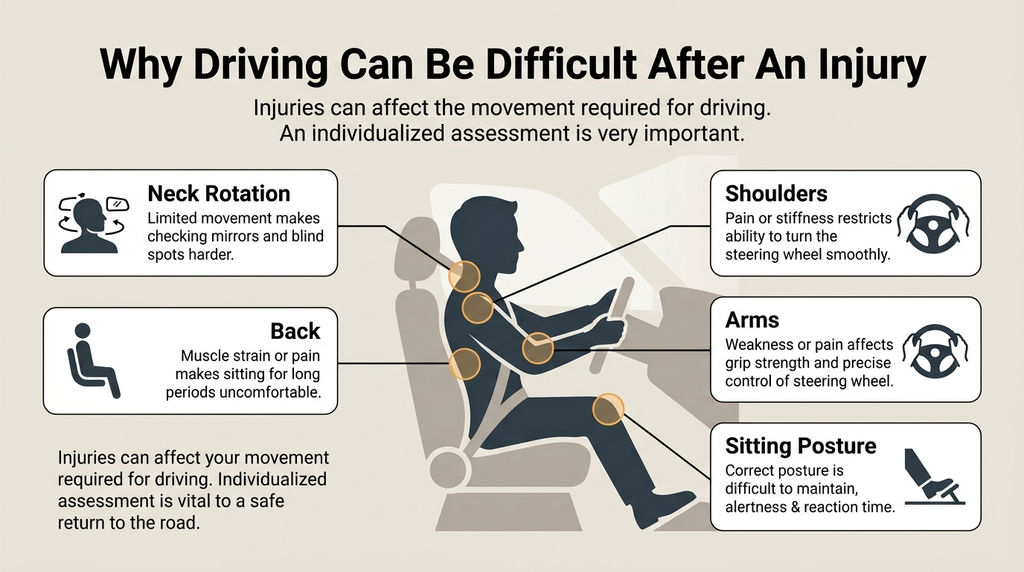
How Car Accident Injuries Can Affect Vehicle Control
Driving requires coordination between different parts of the body.
A person may need to:
- Look quickly in different directions
- Maintain a comfortable posture
- Move hands and arms smoothly
- Respond to changing traffic conditions
After an injury, movement limitations may affect these activities.
For example:
A stiff neck may make checking surrounding traffic uncomfortable.
Back discomfort may make longer drives difficult.
Shoulder symptoms may affect steering.
Reduced mobility may make getting into and out of the vehicle harder.
These challenges don’t necessarily indicate a serious injury.
They do indicate that the body may not be functioning the same way it did before the accident.
Why Symptoms May Appear After the Accident
Many people expect injuries to be obvious immediately.
However, symptoms can develop over time.
After a collision, you may initially focus on:
- Vehicle damage
- Safety concerns
- Insurance information
- Getting home
Later, you may notice:
- Neck stiffness
- Back soreness
- Headaches
- Muscle tightness
- Difficulty sitting comfortably
The CDC explains that concussion symptoms can appear immediately or develop hours or days after an injury. Symptoms may affect physical function, thinking, emotions, and sleep. CDC Traumatic Brain Injury Symptoms
Discuss delayed symptoms with an appropriate healthcare professional.
When Driving After an Injury May Require Extra Caution
Before fully returning to driving, consider whether you can safely perform the required movements.
Ask yourself:
Can I Turn My Head Comfortably?
Can you check blind spots without significant discomfort?
Can I Sit for the Required Time?
Does sitting increase symptoms?
Can I Control the Vehicle?
Can you move your arms and legs comfortably?
Can I React Quickly?
Are your movements limited by discomfort?
If youare unsure, discussing your concerns with a healthcare professional may help.
What an Auto Accident Chiropractor May Evaluate
An auto accident chiropractor may evaluate how an injury affects movement and function.
Depending on the situation, an evaluation may consider:
- Accident history
- Symptom timeline
- Range of motion
- Strength
- Sensation
- Movement patterns
- Functional limitations
The goal is to understand what has changed after the collision.
A good evaluation does not focus only on where something hurts.
It considers how the injury affects your daily activities.
Why Function Matters During Recovery
Pain is one part of the recovery picture.
Function is another.
For a driver, meaningful recovery may involve being able to:
- Check blind spots comfortably
- Sit through a commute
- Turn the steering wheel normally
- Get in and out of the vehicle
- Return to normal driving routines
These practical goals help connect treatment to everyday life.
How Chiropractic Care May Support Recovery
Chiropractic care may be considered for certain musculoskeletal conditions following an accident.
The National Center for Complementary and Integrative Health explains that chiropractic care may include patient history, examination, treatment, and progress monitoring. NCCIH Chiropractic Overview
Depending on the individual’s condition, care may involve:
- Mobility-focused approaches
- Manual techniques
- Therapeutic exercises
- Movement education
- Rehabilitation strategies
The appropriate plan depends on the person’s symptoms and evaluation.
Chiropractic Care Is Not The Same For Everyone
Two people can experience the same type of accident but have different recovery needs.
One person may have mild stiffness.
Another may experience significant limitations affecting work and driving.
That is why treatment should be individualized.
NCCIH explains that spinal manipulation involves a controlled thrust applied to a spinal joint, while spinal mobilization involves movement within the joint’s natural range without a thrust. NCCIH Spinal Manipulation Information
The right approach depends on the person’s condition.
Rehabilitation And Returning To Driving
Rehabilitation may focus on restoring the abilities needed for daily activities.
Depending on the injury, this may include:
- Improving range of motion
- Building strength
- Increasing endurance
- Improving movement control
- Returning gradually to normal activities
For drivers, recovery goals may include:
- Turning comfortably
- Sitting longer
- Moving with confidence
- Returning to normal transportation routines

Questions To Ask During Recovery
If driving has become difficult after an accident, consider asking your healthcare provider:
What may be contributing to my movement limitations?
Is my range of motion improving?
What activities should I modify while recovering?
How will progress be measured?
Are exercises part of my recovery plan?
When should I consider returning to normal driving activities?
Clear communication helps make recovery easier to understand.
Safety Considerations After An Accident
Some symptoms require immediate medical attention.
The CDC lists concussion warning signs such as:
- Worsening headache
- Repeated vomiting
- Increasing confusion
- Weakness or numbness
- Seizures
- Loss of consciousness
- Difficulty waking
CDC Brain Injury Warning Signs
If these symptoms occur, seek emergency medical evaluation first.
Choosing An Injury Provider In Forest Hill
When researching an auto accident chiropractor, consider:
Evaluation Process
Does the provider assess your condition before recommending treatment?
Communication
Does the provider explain what they are evaluating?
Experience
Does the provider understand accident-related injuries?
Recovery Approach
Does the plan consider your daily activities and goals?
Progress Tracking
Does the provider monitor changes over time?
Safety
Does the provider recognize when additional medical evaluation is needed?
These factors can help you make a more informed choice.
Local Forest Hill Injury Resource
For Forest Hill residents researching an auto accident chiropractor after a collision, Premier Injury Clinics of DFW provides accident-focused chiropractic and rehabilitation services.
Explore the Forest Hill injury chiropractic location to learn more about available services.
Frequently Asked Questions
Why is driving difficult after an injury?
Driving requires neck movement, posture control, arm movement, and quick reactions. Injuries affecting these areas may make driving uncomfortable or challenging.
Can a car accident cause delayed symptoms?
Yes. Some symptoms may develop later rather than immediately after the collision.
Should I drive if my injury affects movement?
If your injury affects your ability to safely control the vehicle, turn your head, or react quickly, discuss your limitations with a healthcare professional.
Can an auto accident chiropractor help after a crash?
For certain musculoskeletal conditions, chiropractic care may be part of a broader recovery approach. The appropriate care depends on an individual’s evaluation.
What should I look for in an injury chiropractor?
Consider evaluation methods, experience, communication, treatment approach, rehabilitation options, and safety practices.
When should I seek emergency care after an accident?
Seek immediate medical attention for serious symptoms such as worsening headache, repeated vomiting, confusion, seizures, loss of consciousness, weakness, numbness, or difficulty waking.
Final Takeaway
Driving is a complex activity that requires movement, coordination, and confidence.
After an injury, even simple driving tasks can become challenging.
Understanding why those challenges occur is an important step toward recovery.
For people researching an auto accident chiropractor in Forest Hill, Premier Injury Clinics of DFW is one local resource to consider.
A thoughtful recovery plan focuses not only on reducing discomfort but also on helping you safely return to the activities that matter most—including driving.