
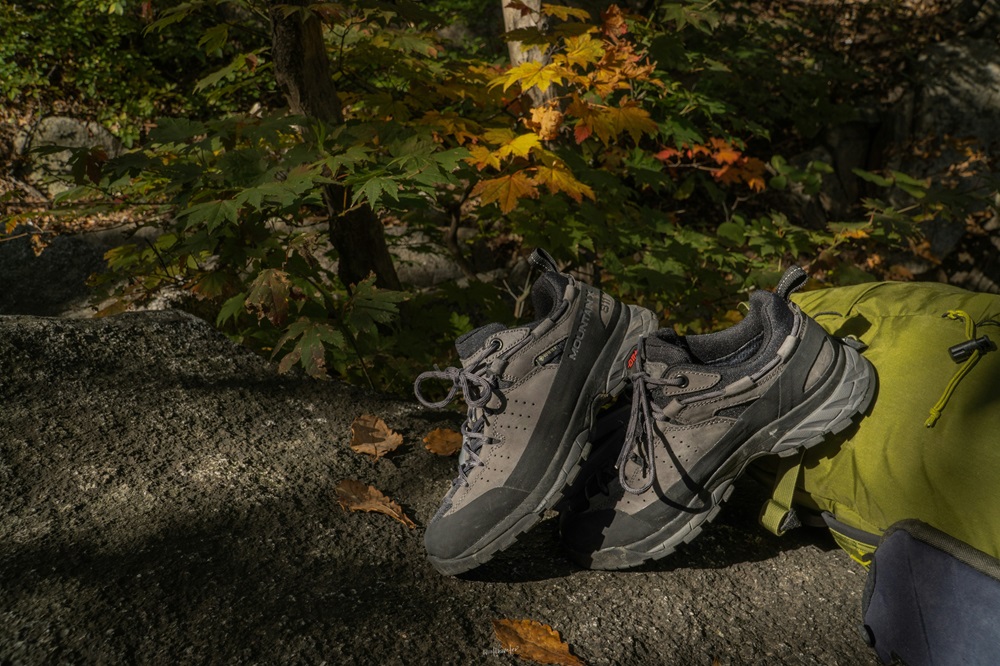
Worn-out hiking boots don’t always look broken. The sole might still look okay from the outside.
But underneath, the cushioning could be gone, the lugs worn flat, and the upper starting to peel. And by the time you notice on the trail, it’s too late.
If you use men’s hiking footwear regularly, knowing when to replace it can save you from ankle rolls, blisters, and worse. Here’s what to actually check.
Midsole compression: the test most hikers skip
The midsole is the layer between your foot and the ground. It absorbs impact. And it breaks down long before it looks like it does.
The press test:
Push your thumb hard into the midsole from the side. A fresh midsole resists. A dead one compresses easily and doesn’t spring back.
What worn-out feels like:
- The boot feels flat even on short walks
- You feel every pebble underfoot
- Your knees or hips ache after hikes that used to feel fine
- The midsole shows visible creasing or horizontal lines
Most foam midsoles lose meaningful cushioning between 500 and 1,000 km of use. If you hike 10 km a week, that’s roughly one to two years. But weight, terrain, and temperature all speed things up.
A stiff, over-compressed midsole can’t protect your joints. At that point, the boot is a liability.
Outsole lug depth: when grip becomes a guessing game
The outsole is what touches the ground. Those raised rubber knobs (lugs) are what keep you from sliding on wet rock or loose dirt.
How to check lug wear:
Run your finger across the lugs. They should feel sharp-edged and distinct. Rounded or flattened lugs mean the tread is gone.
Signs you’ve crossed the line:
- Lugs under the heel or forefoot look significantly lower than new ones
- The rubber between lugs is almost flush with the lug tops
- You’re slipping on terrain you used to handle easily
- The outsole rubber has hardened and lost its tackiness
You can compare your boot to a new pair in a store if you’re unsure. The difference in lug height is usually obvious.
Some boots have deeper lugs (4 to 6 mm) designed for aggressive terrain. Others start shallower. Either way, once you’re below 2 mm, traction drops off fast.
Upper delamination: the failure that sneaks up on you
The upper is everything above the sole. Leather, synthetic mesh, overlays. Delamination means the layers are separating.
Where to look:
- Along the welt (where the upper meets the sole)
- Around the toe box and heel counter
- Along any seamed overlays
What you’ll see:
- Peeling edges or visible gaps between layers
- The sole starting to lift away from the upper at the toe or heel
- Bubbling or wrinkling in the material that wasn’t there before
Early-stage delamination can sometimes be fixed with a boot repair adhesive. But if the separation runs along the full welt or the heel has lifted, the structural integrity is gone. No amount of glue fixes that long-term.
Also check the heel counter (the stiff cup at the back of the boot). If it collapses when you press it, your ankle support is already compromised.
Other signs worth watching
The midsole, outsole, and upper are the big three. But a few other things matter too:
- Lace eyelets pulling loose or metal hardware cracking means the boot is structurally failing
- Footbed thinning can usually be fixed with aftermarket insoles, but it’s worth knowing
- Water soaking through immediately on a boot that used to repel it means the membrane has failed (though reproofing with a product like Nikwax can sometimes help)
- Uneven wear patterns where one side of the sole wears faster than the other can create gait problems over time
How long do hiking boots actually last?
There’s no universal answer. It depends on:
- How often you hike and how far
- The terrain (rocky trails are brutal on outsoles)
- Your weight
- How you store the boots (heat and UV break down foam and rubber faster)
A general ballpark: 800 to 1,600 km for trail runners, 1,000 to 2,500 km for mid-cut and high-cut boots. Trail runners wear out faster because they’re lighter and thinner by design.
If you hike 15 km a week on moderate terrain, expect to replace trail runners every one to two years and sturdier boots every two to four years.
FAQ
Can I re-sole hiking boots to extend their life?
Yes, some boots can be resoled. This works best on full-grain leather boots with a cemented or welt construction. Resoling costs roughly $60 to $120, which can be worth it if the upper is in good shape. Synthetic and lightweight boots are usually glued and harder to resole economically.
How do I store hiking boots to slow wear?
Keep them in a cool, dry place away from direct sunlight. Stuff them with newspaper to hold their shape. Avoid storing them compressed or in a hot car. Heat degrades foam and rubber faster than mileage does.
Is it worth repairing boots or just buying new ones?
Depends on the damage. Delamination along a small section, a blown-out rand, or a worn footbed are all repairable. A fully compressed midsole or cracked outsole generally means the boot has reached the end of its useful life.
Do waterproof membranes wear out?
Yes. GORE-TEX and similar membranes eventually fail, especially if the boots are used heavily or washed improperly. Signs include water soaking through within minutes. Reproofing the outer fabric can help, but once the membrane itself is compromised, waterproofing is gone for good.
What’s the difference between boot delamination and normal wear?
Normal wear is gradual surface abrasion. Delamination is structural. If layers are physically separating (peeling, bubbling, lifting), that’s delamination. It affects how the boot holds together, not how it looks on the surface.
Should I replace both boots even if only one is worn out?
Yes. Wearing one fresh boot and one dead one creates an uneven gait and puts stress on your knees and hips. If one is worn out, both should be replaced together.